SB-9: How Senate Bill 9 ADU Increases Aim to Solve Housing Supply Shortages through Lot Splits and ADUs
California Senate Bill 9 (SB-9) is a state law that requires local cities to grant “by-right” (ministerial) approval for homeowners to build up to two primary residential units or an ADU on a single-family lot, as well as subdivide their property. It essentially legalizes multi-unit housing in traditionally single-family zones.

What is an ADU?
An ADU stands for Accessory Dwelling Unit. California difines it as an additional housing structure built on an existing Single-Family Residence lot. Even though it’s not zoned multi-family. In 2017, laws went into effect making it easier for an ADU to be added to any single-family city lot, and again in 2022, making rural lots eligible, with the ability to split your lot if it’s large enough. We detail the specifics throughout the rest of this write-up.
ADUs have known many names: granny flats, in-law units, backyard cottages, secondary units, and more. No matter what you call them, ADUs are an innovative, affordable, and effective option for adding much-needed housing in California. The number of beneficial local ADU ordinances has grown exponentially as more cities, counties, and homeowners become interested in ADUs as one solution to increasing the supply of affordable housing.
Benefits of ADUs
- ADUs are an affordable type of home to construct in California because they do not require paying for land, major new infrastructure, structured parking, or elevators, and they benefit from Senate Bill 9 housing laws.
- ADUs can provide a source of income for homeowners.
- ADUs are built with cost-effective wood frame construction, which makes ADU construction significantly less costly than homes in new multifamily infill buildings (ex., above-garage ADUs)
- ADUs allow extended families to be near one another while maintaining privacy.
- ADUs can provide as much living space as many newly built apartments and condominiums, and they’re well-suited for couples, small families, friends, young people, and seniors.
- ADUs give homeowners the flexibility to add an attached or detached ADU to share independent living areas with family members and others, allowing seniors to age in place as they require increased care.
SB-9 (Slide Summary)
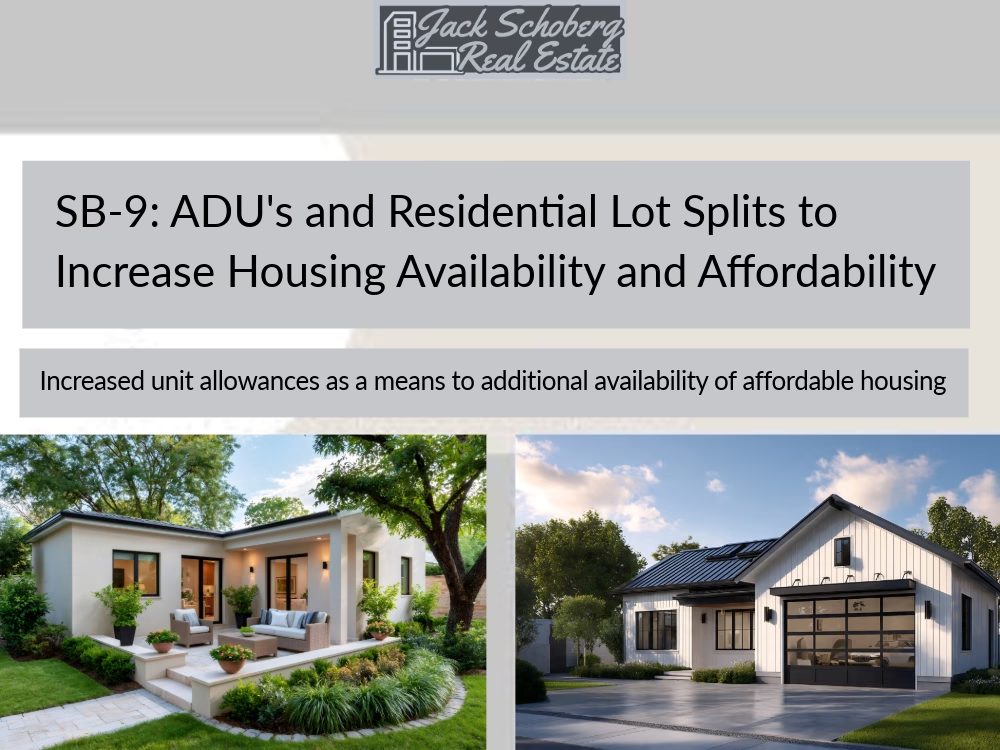
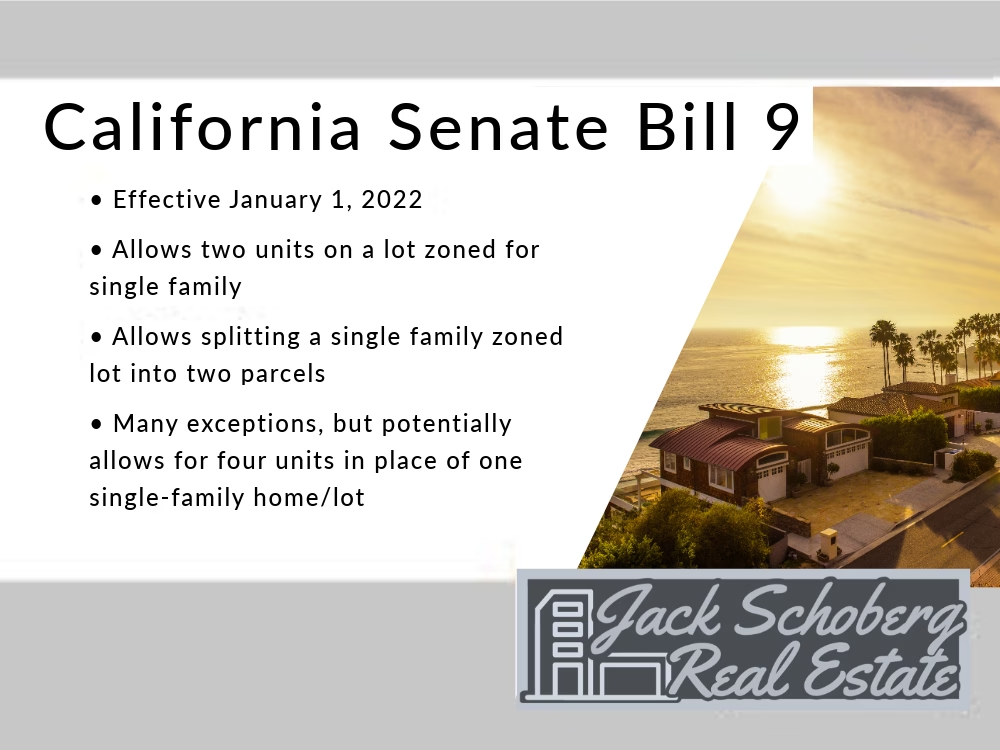
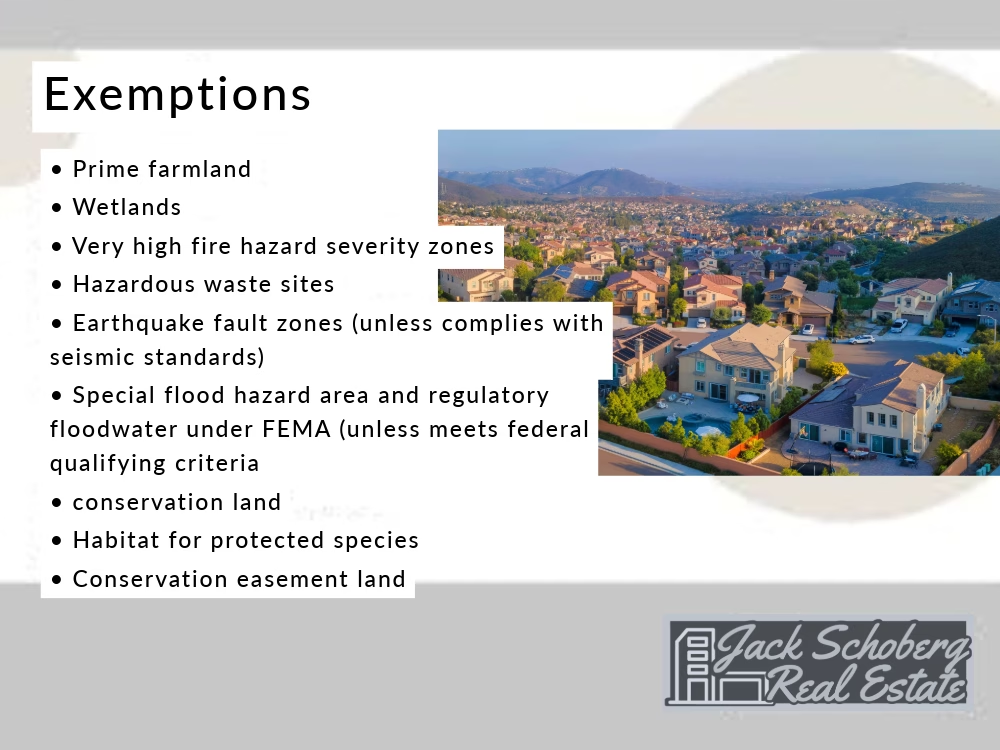
View the following eight slides for a summary of Senate Bill – 9 California ADU laws.
Passed in 2022, SB-9 overrides density laws in single-family zoned residential areas. This allows ADUs to be built to help ease housing demand and increase affordability.

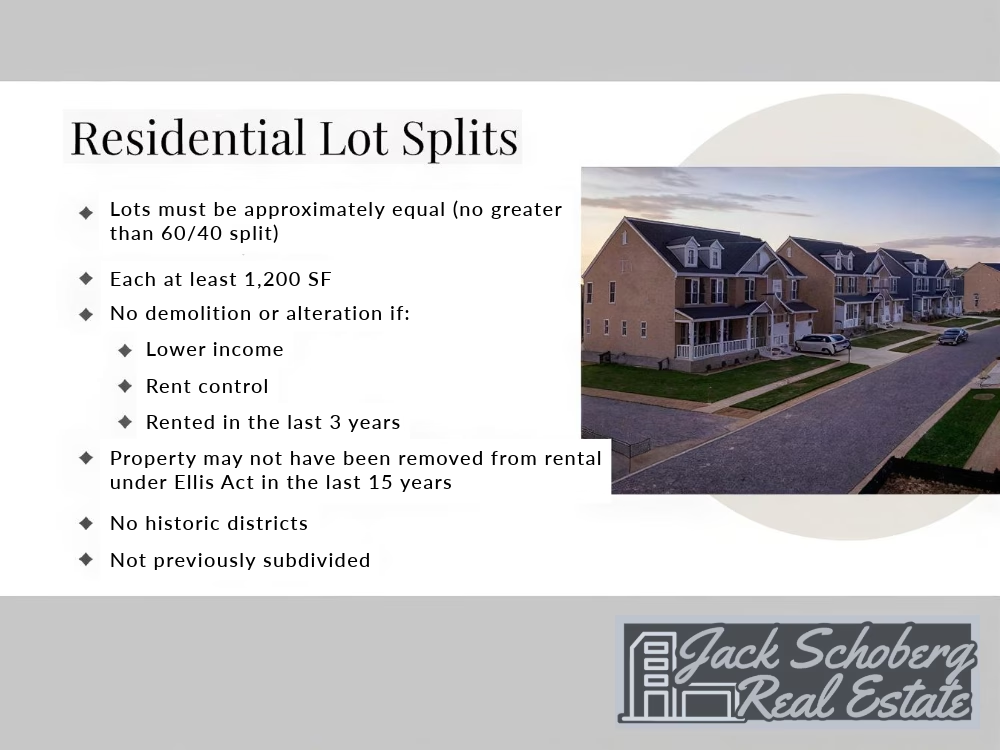
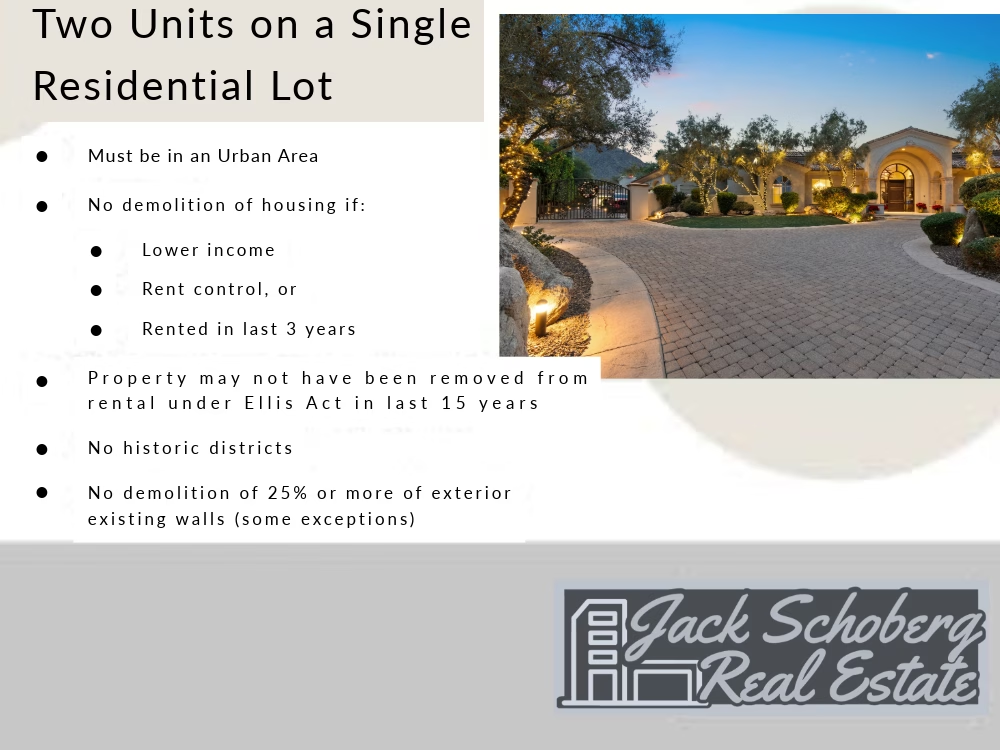
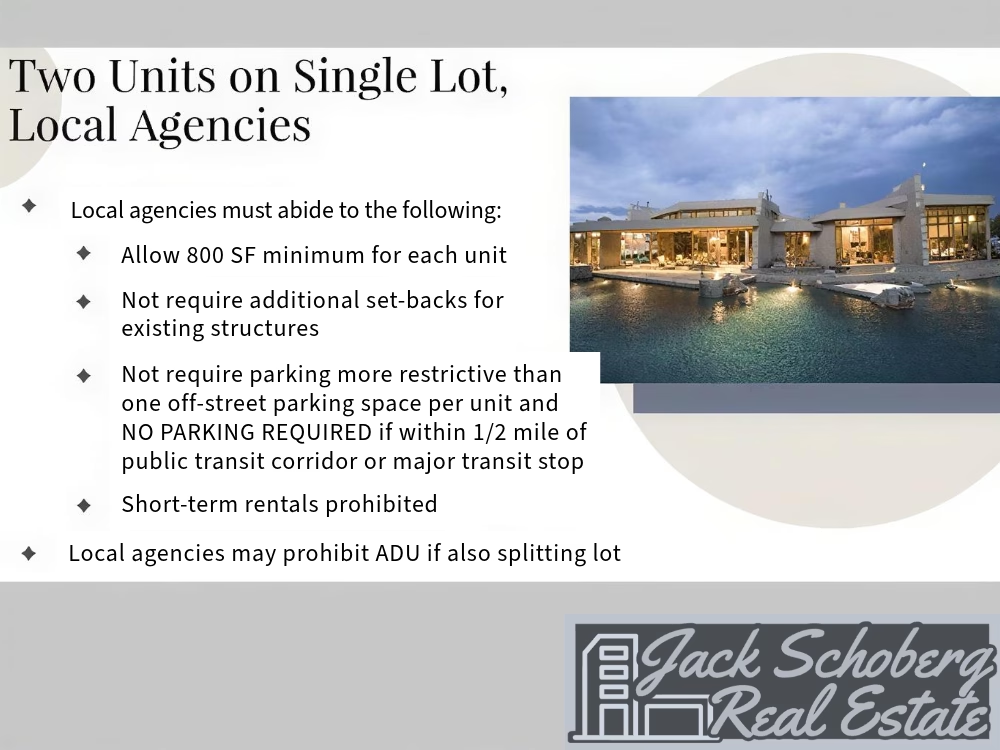
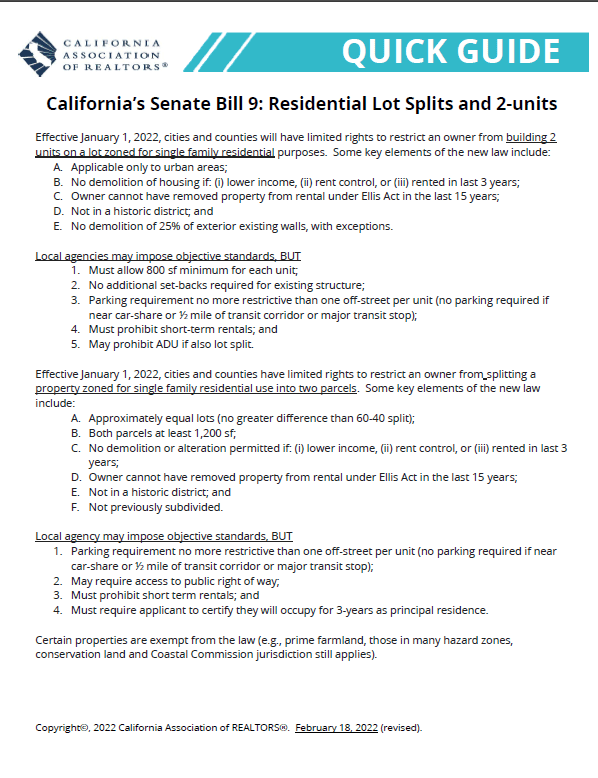
Example Use Cases for SB-9 Lot Split & ADU Laws
To take advantage of SB-9 (while creating additional much needed rental units) you can start by searching for suitable properties. The minimum requirements for a lot split is a single-family home with a 2,400 sq ft min. lot size. This can be split into two 1,200 sq. ft. min. sized lots. One ADU can be built on the lot with the original home. Two more units can be built on the new lot after the split. Each of the three new units must be sized 800 sq. ft. minimum.
Luckily, there are many properties that meet the requirements throughout California. To locate potential properties you should work with an experienced agent. They will be able to set up the search criteria to find matching properties. That way, you can receive a list of matching properties plus new ones as they become available. Your agent can also recommend any needed contractors to help you complete your goals. Real estate agent Jack Schoberg routinely handles these types of tasks. He’s an excellent choice, especcially considering he refunds 1.25% of your property’s price tag upon successfully closing escrow.
ADU Programs: ADU Funding for Homeowners
- The California Health and Safety Code (HSC), Section 65583(c)(7), mandates that cities and counties develop plans to incentivize and promote the creation of ADUs offered at affordable rent for low income households.
- As recapped below, HCD has developed a list of existing state grants and financial incentives in connection with the expenses for the planning, construction, and operation of an ADU with affordable rent for very low to moderate-income households.
- City of Clovis: ADU Finance Program — Provides financing to eligible property owners seeking funding to build or repair ADUs on their existing single-family lot in the City of Clovis.
- Santa Cruz County: ADU Forgivable Loan Program — Offers forgivable loans up to $40,000 to homeowners who rent ADUs to low-income households at affordable rents for up to 20 years.
- San Mateo County: One Stop Shop Program — Provides no-cost support from Hello Housing with the design, permitting, and project management involved with building an ADU.
- Monterey Bay: My House My Home Program — Creates affordable ADUs for low-income senior homeowners in the Monterey Bay area.
- City of Chico ADU Program — Provides pre-approved ADU plans and support for ADU construction meeting California ADU laws.
- Housing Trust Silicon Valley — Provides funding to support homeownership, rental housing, development financing, and offers programs for homeowners.
- CalHFA’s ADU Grant Program – Effective on or after September 20, 2021, the CalHFA ADU Grant Program will provide up to $25,000 in assistance to reimburse homeowners for the pre-development costs that are necessary to build and occupy an ADU.
Accessory Dwelling Unit Handbook – Effective January 1, 2021
The Legislature further updated Senate Bill 9 ADU and JADU laws effective January 1, 2021. This clarifies and improves various provisions to promote the development of ADUs and junior accessory dwelling units (JADUs). For example, allowing ADUs and JADUs built concurrently with a single-family dwellings. Additionally, it expands zoning districts to include all that allow single-family and multifamily uses to allow ADUs. It also modifies fees from utility special districts and water corporations. Please see the Accessory Dwelling Unit Handbook (PDF) for more information.
Additional Guidance
- California State Fire Marshal (PDF) — Information bulletin regarding sprinkler system requirements.
- CalHFA (PDF) — Bulletin for ADU income, which includes anticipated income from the planned ADU to qualify for a loan to create the ADU.
- California Energy Commission updates for ADU:
- Blueprint Newsletter Issue 129 January 2020 – March — ADUs and adoption of 2019 Energy Code: PV (solar panel) Requirements for ADUs
- California Department of Housing and Community Development (PDF) — Information Bulletin providing clarification and outlining provisions of various residential types, ranging from recreation vehicles and manufactured homes to site-constructed California Building Standards Code dwellings.
- For ADUs in Coastal Commission areas:
- Implementation of New ADU Laws — April 21, 2020
- ADU guidance memo for planning directors in coastal cities and counties (PDF) — April 18, 2017
- ADU guidance memo update (PDF) — November 20, 2017
- ADU guidebook — City of Los Angeles
Research
- About Accessory Dwelling Units — An evaluation of local ADU ordinances and opportunities to foster more ADU construction (Institute of Governmental Studies, Center for Community Innovation (CCI), UC Berkeley)
- Reaching California’s ADU Potential: Progress to Date and the Need for ADU (Terner Center for Housing Innovation – UC Berkeley). To further increase the number of ADUs for low/moderate-income homeowners, additional financial tools are needed to facilitate the creation of ADUs
- The ADU Scorecard – Grading ADU Ordinances in California (UC Berkeley Center for Community Innovation, 2020)
- ADU Update: Early Lessons and Impacts of California’s State and Local Policy Changes provides an overview of ADUs as a housing solution for California. Covers recent policy changes at the state and local level, California’s progress to date, and remaining barriers. Written by David Garcia at the Terner Center (U.C. Berkeley), December 2017
Guidance from ADU Handbook contributors
- Casita Coalition — ADU Best Practices Guidebook — 2021 Webinar Series Summary. A summary of Best Practice webinars held in 2021, featuring local jurisdictions and other agencies finding innovative ways to promote ADUs.
- Casita Coalition — Finance Guide for Homeowners and Guidelines for Converting Garages to ADUs
- Casita Coalition — See the video “Why ADUs”
- Learn about creating an ADU in Napa or Sonoma County, including informative webinars, Napa Sonoma ADU
- ADU plans available from cities and counties:
- Pre-approved ADU plans, and a “Guide to Building Accessory dwelling Units” from the City of Stockton
- ADU amnesty program, with an ADU idea book and cost estimator, in San Mateo County for existing ADUs constructed without necessary permits and approvals. — ADU amnesty program
- American Planning Association (APA) webinar for ADU statute updates, effective January 1, 2020 — Technical assistance (TA) presentation addressing the updates to accessory dwelling unit and junior accessory dwelling law, effective January 1, 2020.
- ADU Resource Center, the American Institute of Architects (AIA)
- The ABCs of ADUs — A guide to Accessory Dwelling Units and how they expand housing options for people of all ages (from AARP)
- Clovis Cottage Home Program — Promotion of infill residential development on qualified properties in the Old Town area with city-provided floor plans, building permit package, and fee-waived checked plans
- Everything About Building ADU in Los Angeles — Although the City is still in the process of adopting an ADU ordinance, this fact sheet provides guidance for types of ADU, parking, current building codes, cost estimates, potential rental rates, and more.
- Second Unit Resources Center — Although focused on San Mateo County, this website can serve as a great model for other sites. It includes:
- Ideas, Stories, and Photos
- How to Build an ADU— A step-by-step guide from design to move-in
- Second Unit Calculator— Calculate typical costs, rents, and more
- Idea Book
- Workbook
Contact Jack to find a suitable property for a lot split or to add an ADU under Senate Bill 9.
Plus, receive a commission rebate for up to 1.25% of the purchase price.